Tuesday, May 26, 2009

The Giver. Solution to today's problems


One of the problems we have in our world today is divorce. In The Giver they have solved this problem by having applications to be given a spouse. You are given a spouse when the committee thinks you are ready to raise a family. At first you only get one child when you are assigned your wife but then later you apply for the second and if you are ready they will give you a second child. I think this solution is pretty good. If you get divorced you will lose your concentration and be depressed. As a result you won't work as hard and that could ruin the system of the community.

Monday, February 2, 2009

Dating the Information

Cultural Dating: When archaeologists are looking through one layer of earth and they find a small object with a statue or a face on it. They then will look at information from that country and try and look when the statue or face ( which will probably be someone in control) was alive or made. They then will use that information to date that object.

Absolute and Relative Dating: Absolute dating is when archaeologists have an exact date of when the object was made. Relative dating on the other hand is when archaeologists don't have a date of when the object was made. So they mostly tell if the object is older or newer than other objects.

Scientific Dating: Is when archaeologists don't know how old a object is so they take it to a laboratory and examine it. Scientific dating hasbenn going on for more than 3 centuries. It started in the 1700's with natural rings appear on tree's the thickness depends on the weather. When you want to know how old a tree is you would count up the rings . Then if you want to know how old a wodden object you would look at the ring pattern.

Radiocarbon Dating: Is when scientist don't know when a object is from. So they usd radioactive carbon but on objects which use to be alive like wood or plants. They do this by figuring out how much carbon the thing absorbed while it was a live and then they count how much carbon is left after the amount of years of decay. But there are some bad things to this technique like even the smoke from a cigarette can affect the accuracy.


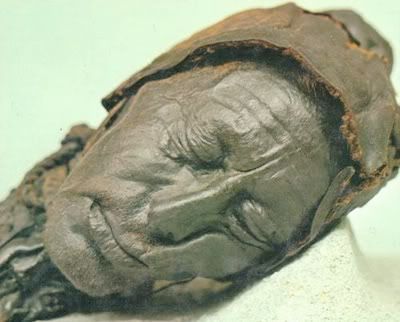
The acid from the bog preserved ancient peat harvesters from centuries ago.

Current peat harvesters keep finding old bog bodies.

The body is so preserved that scientists can examine it like a normal person that died recently.

The bodies in Florida have no skin but still have brains and other organs.

Someone was digging a pond for a house but noticed bones sticking out of the ground.

Some of the bodies had wodden poles stuck through there clothes.

10,000 bodies were found in the peat pond in Windover.


Tollund man's hat is made out of sheep skin.


His face is still is perfectly in tact even hi brain is preserved.


His brothers found him while they were cutting peat.

Sunday, February 1, 2009

Unlocking the record

Ben Clark
2/2/09
Social Studies activity

The Formation of the record is when ruins of a object from the past is covered in soil and then trees and grass cover the ruins. Eventually wind and erosion of the soil eventually uncover some of the ruins. Another way the ruins can be uncovered is animals can dig holes and found the remains or farmers may uncover the ruins. Otherwies scientists must use excavation which is when they dig up the ruins.

The excavation of a site is when

Thursday, January 29, 2009

1. What methods and sources do historians use to learn about the past?

They would use as many different sources as possible including written and non-written sources. They would then try to understand the meaning of them. Historians collect information, they examine it and then interpret it.


2. Is the map on page 39 a primary source or a secondary source? Why?

It is a secondary source because this map was drawn later than the event actually occured.


3. Why do historians ask questions about their sources?

They ask about their sources to see how accurate and useful they are.


4. In ancient Rome fewer women than men left behind written sources. How might this affected historians knowlodge of the history of Rome?

It shows the point of veiw more to men than women as they would write about what was important to them.


5. Look around your house. What written and non written sources do you see? Make a list of the sources. Then using 1 of 2 of you sources on your list try to write about the history of your family. Follow Thycudides' advice as write and evaluate your sources carefully.

Written:
  • Photo 1/1/2000
  • Coro painting Annete More 1999
  • Cross Stich 22/4/95
  • Photo albums
  • Painting 8/8/2002
Unwritten:
  • Statue
  • Gong
  • Elephant statue
  • Oil lamp
  • Photo borrobadur

My parents were married on 22 April 1995 in New Zealand and then they moved Caracas, Venezuela. I was born on the 25th of Febuary 1997. During the 6 years I lived there, on November 26th 1999 my little brother Daniel was born. He turned out to be a nightmare because as we grew up he used to copy me a lot. A little less then 2 years later, on November 7th 2001 my little sister Jessica was born. We travelled around Venezuela to Maracaibo, Coro and other places, and we have paintings from these visits. About 11 months after she was born we moved to Sri Lanka. In the first month we were there, we got a maid named Nirmalee and Jess adored her through the whole time we lived there. Sri Lanka is a buddist country and they use oil lamps and elephants for special ceremonies. But 2 and 3/4 years later the company moved us to Jakarta which sounded exciting and we actually when got here it wasn't half bad except for the heat and traffic. We have visited Yogyakarta and Borrobadur.

Tuesday, November 18, 2008


1.In your own words, explain what the title of this article means.
It means that the goverment failed to keep the groundwater exploitation under control.

2.According to the article, who is taking a lot of water out of the aquifer?
70% of Jakarta and the high rise buildings.

3.If you take a lot of water from the aquifer, what three things happen?
Salt water introusion, a fine of 5 million rupiah and land subcidence

4.What is the punishment for taking more water than your permit allows?
A fine of 5 million rupiah or 6 months in jail.

5.Do you think this punishment will stop people taking too much water from the aquifer? Why?
No it won't because the high rise building owners will take more and they have plenty of money to pay the fine plus that isn't very much to them

6.Jakarta’s aquifers are being contaminated by sea water.
What else is contaminating Jakarta’s groundwater? The septic tanks leaking there waste too close to wells

7.What evidence is there for the additional contamination in number 6?
That most of the wells are 2 or 3 meters apart when they should be at least 10 meters apart.

Wednesday, November 5, 2008


Septic Tank:A sewage-disposal tank in which a continuous flow of waste material is decomposed by anaerobic bacteria. It stays in there until the waste is liquidy enough to soak in to the ground. It usually is round and is underground.


Water Pressure:Force of something pushing which sends it at high speed or high pressure. That is why the water from the shower is coming fast when you turn it on.


Unprocessed:Water that has not been treated ar been put through a special process which then cleans it. Like soapy water that was dumped straight on to the grass instead of down the drain.


Groundwater:Water that seeps through the soil or rocks underground and stops after it passes the aquifer. Which then forms puddles and stores until a well is dug into it


Reservoir: A large or extra supply or stock; reserve. It is a man made ditch which is very large. It stores alot of water that has been processed but stays there until it is taken out and used. In Indonesia the major reservoir is Jatilahur.